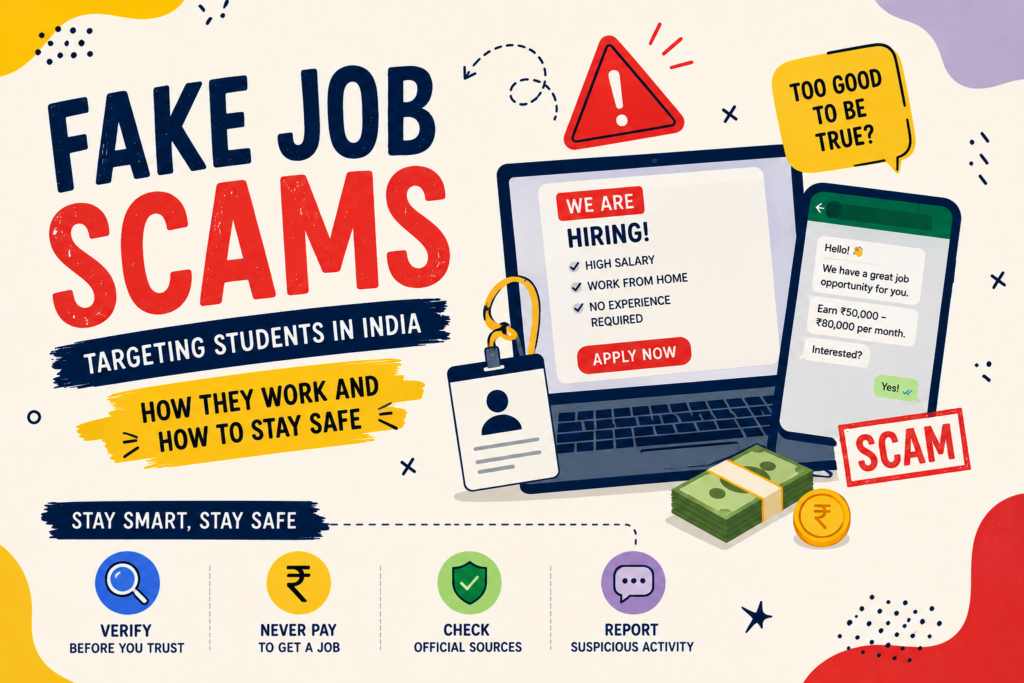
Fake Job Scams Targeting Students in India: How They Work and How to Stay Safe
A single WhatsApp message. A promise of Rs 3,000 per day. No experience required. This is how thousands of Indian students lose their savings every year, and why you need to read this before you respond to the next offer.
- How big is the fake job scam problem in India
- Why students are the primary target
- 5 types of fake job scams students must know
- The Telegram prepaid task trap explained
- Real cases from across India
- Red flags in every fake job offer
- How to verify if a job offer is real
- Rules every student must follow
- If you have already been scammed
- Report to Scam Shield India
It arrived as a message from an unknown number. Simple task. Good pay. Work from your phone. No experience needed. It sounded like exactly what you needed. That is exactly what they planned.
India has a jobs problem. There are more graduates than there are opportunities, and the pressure on students to earn, to gain experience, and to build a career starts earlier than ever. Scammers have studied this pressure carefully. They know what a student needs to hear, and they have built entire systems designed to say exactly that, and then take everything.
Fake job scams are now consistently among the top reported cybercrimes in India every quarter. In April 2025, UP Police cracked down on a job scam that had siphoned crores from over 1.2 lakh victims across India, all through fake recruiters on job portals. And that is only one operation among hundreds.
Sources: ScamDekho, Cybercrime.gov.in, JobsBob Research 2025
How Big Is the Fake Job Scam Problem in India
Work from home and part-time job scams are consistently among the top reported cybercrimes in India every quarter. These numbers represent only reported cases. Thousands of victims, especially students and homemakers, never file a complaint at all. Some feel ashamed. Some do not know where to report. Some believe nothing will come of it anyway.
The real number is far higher than any statistic shows. And as UPI makes micro-payments easier and Telegram provides near-anonymous group management, the infrastructure for running these scams at scale has never been cheaper or simpler for fraudsters.
A survey revealed that 70% of respondents encountered fake job offers for non-existent positions, and 26% came across fraudulent recruitment agencies exploiting job seekers' trust. These are not edge cases. This is the mainstream job search experience for millions of young Indians.
Why Students Are the Primary Target
Scammers do not pick victims randomly. They go after people who are most likely to be financially stretched and least likely to verify carefully before acting. Students are at the top of that list for specific reasons.
A college student needs money for fees, books, hostel expenses, and daily needs. They are under time pressure and cannot afford to miss an opportunity. They are often applying to dozens of jobs simultaneously and have developed a habit of responding quickly. They want experience on their CV and are willing to start at low pay. And they have grown up trusting digital communication, which makes a professional-sounding WhatsApp message from a recruiter feel completely normal.
Scammers know all of this. The promise of earning Rs 500 to Rs 5,000 per day with no skills required, no experience needed, and work from your phone is not a random pitch. It is carefully designed to appeal to someone who feels like options are limited and time is running out.
We are currently hiring for part-time online work suitable for students. Work from your phone, 2 to 3 hours daily.
Earnings: Rs 1,500 to Rs 4,000 per day
No experience required
Immediate joining available
Interested? Reply YES to get started.
5 Types of Fake Job Scams Students Must Know
Prepaid Task Scam (Telegram and WhatsApp)
You are offered simple tasks: like a YouTube video, rate a product on Google, follow an Instagram account. You actually receive small payments of Rs 150 to Rs 500 to build trust. Then you are told about "premium tasks" that require depositing money to unlock higher returns. Rs 3,000 becomes Rs 10,000 becomes Rs 50,000. At some point the group disappears, the number goes dead, and you have lost everything you put in. Cybercrime authorities specifically flag these as task-based or investment-linked job frauds.
Fake Company Impersonation with Processing Fee
Fraudulent recruiters create professional-looking fake websites and conduct fake interviews, mimicking real companies like Infosys, TCS, Amazon, or government organizations. After a convincing process, they offer you a job and ask for a "processing fee," "registration fee," or "training fee" to complete your onboarding. Legitimate companies never ask candidates to pay for hiring. Once the fee is paid, the recruiter disappears or demands more payments.
Fake Internship Certificate Scam
Companies have sprung up in cities like Noida solely to issue internship certificates for a fee. They offer attractive-sounding roles at prestigious-sounding organizations, take a payment for "processing," and issue certificates that multinational companies do not recognize, rendering them worthless for actual job applications. Students pay for experience they never receive and credentials that actively harm their careers.
Fake Government Job Offer
Scammers impersonate government recruiters from organizations like ISRO, DRDO, Railways, or state PSUs. They send convincing offer letters on fabricated letterheads, collect application fees or "security deposits," and vanish. In one documented case, an engineering student collected Rs 3,000 from 84 aspiring candidates by faking an ISRO recruitment drive, complete with a fake website and email ID mimicking the organization.
Fake Job Portal Data Harvesting
Fraudulent job portals that copy the design of legitimate websites like Naukri or LinkedIn ask you to create an account and submit your full profile: Aadhaar number, PAN card, bank account details, and address. This data is then sold on the dark web or used directly to open fraudulent accounts in your name. You never hear from the "employer" again, but your identity is already compromised.
The Telegram Prepaid Task Trap: A Stage-by-Stage Breakdown
This is the fastest-growing job fraud category in India right now. It is important to understand every stage of how it works, because each stage is designed to make the next step feel completely reasonable.
The first message arrives
You receive an unsolicited WhatsApp message, SMS, or Instagram DM promising Rs 2,000 to Rs 5,000 per day for simple online tasks like likes or reviews. The tone is friendly and professional. No joining fee is mentioned. You are redirected to a so-called "HR executive" on Telegram.
They actually pay you
You are asked to like a YouTube video, rate a business on Google, or follow a social media account. You complete the task and receive Rs 150 to Rs 500 directly in your UPI account. This payment is real. It is an investment the scammer makes to gain your trust. You believe the job is legitimate.
You are upgraded to a premium group
After a few paid tasks, you are invited to a "VIP Task Group" or "Premium Members Group" on Telegram. The group has hundreds of members posting screenshots of large earnings. These are fake accounts operated by the scammer. The atmosphere feels like a legitimate, thriving community of earners.
You are told to invest to unlock higher earnings
You are introduced to "prepaid tasks." Depositing Rs 2,000 returns Rs 3,500. Depositing Rs 5,000 returns Rs 7,500. The first one or two may even pay out, drawing you deeper. Then the amounts escalate sharply. Rs 10,000, Rs 25,000, Rs 50,000. Each deposit is framed as unlocking the next, higher-paying level.
The group disappears overnight
At the peak of your investment, when you have deposited the largest amount, the Telegram group is deleted, the number goes silent, and the website goes offline. You have no way to trace the scammer. The entire operation moves to a new set of numbers and a new group and finds new victims the same day.
The early payments are not proof that the job is real. They are the cost of running the scam. For every Rs 500 paid out, the scammer recovers Rs 50,000 or more from the same victim at a later stage. The initial payment is a calculated investment in your trust.
Real Cases from Across India
A victim in Mandamarri, Telangana was approached via Telegram with an offer to earn money by posting Google reviews. He received initial payments and was added to a VIP group. After being encouraged to deposit Rs 10,000 for a "premium task," he lost Rs 2.12 lakh in total before realizing the withdrawal option had been disabled.
Lesson: The inability to withdraw your balance is when most victims realize they are trapped. By then, the deposits have already been made.
A homemaker from Navi Mumbai lost Rs 26 lakh in a Telegram-based work-from-home scam that asked her to perform fake ticket bookings. Each task required a deposit to unlock the next. The scammer continued escalating the amounts over several weeks, maintaining the fiction of "processing delays" to explain why withdrawals were not yet available.
Lesson: Scammers extend the deception over weeks to maximize total deposits before disappearing.
In April 2025, UP Police dismantled a call centre in Kanpur running a massive fake recruitment operation. Scammers posed as recruiters from well-known companies, used fake websites and caller ID spoofing, and defrauded over 1.2 lakh job seekers across India. The gang used Naukri.com profiles to source victim contact details and targeted freshers and students specifically.
Lesson: Fake recruiters actively mine legitimate job portals for victim contact details. Uploading your resume on Naukri or LinkedIn does not guarantee the people who contact you are real.
🛡 Received a suspicious job offer? Report it before someone else falls for it.
Report to Scam Shield IndiaRed Flags in Every Fake Job Offer
Almost every fake job scam follows a predictable script. Once you know the pattern, you will spot it immediately.
Reject the offer immediately if any of these are true
- The contact comes from an unknown personal number on WhatsApp, not from a company email or official recruiter profile
- The pay promised is unrealistically high for simple tasks: Rs 2,000 to Rs 5,000 per day for liking videos or rating apps
- They ask for a "registration fee," "processing fee," "security deposit," or "training fee" at any point
- They ask you to join a Telegram group and "invest" to unlock higher-earning tasks
- There is no interview process, or the interview is extremely informal and takes place over WhatsApp
- The company name sounds similar to a real company but the domain or contact details are slightly different
- They ask for your Aadhaar, PAN, or bank account details before any official offer letter is issued
- They ask for an OTP at any point during the recruitment process
- The offer letter arrives on letterhead that looks slightly off, with spelling errors or misaligned logos
- They pressure you to decide immediately: "This offer is only available for the next 2 hours"
These platforms are most commonly used to deliver fake job offers. Being contacted through any of them by an unknown recruiter should trigger immediate verification:
How to Verify If a Job Offer Is Real
Before you respond to any job offer, spend five minutes on these checks. They will tell you everything you need to know.
Search the company name on Google independently
Do not click links the recruiter sends. Search the company name yourself and look for a legitimate website, LinkedIn page, and news coverage. If none exist or the website looks new and generic, it is a fake.
Check the email domain of any correspondence
A real company recruiter will contact you from a company domain like @infosys.com or @amazon.in. If the email comes from Gmail, Yahoo, or a look-alike domain like @infosys-recruitment.com, it is a scam.
Look up the recruiter on LinkedIn
A legitimate HR professional will have a verifiable LinkedIn profile with work history, connections, and activity. If the recruiter has no LinkedIn presence or a very new, sparse profile, do not proceed.
Call the company's official number directly
Find the company's official customer care or HR number from their verified website and call to confirm that the recruitment is real and that the person who contacted you is employed there. Legitimate companies will confirm this immediately.
Verify the offer letter format and details
Look up sample offer letters from the company online. Check the letterhead, logo quality, signatory name, and company registration number mentioned in the document. Government recruitment letters will always have an official gazette notification number that can be verified.
Remember the golden rule: legitimate employers never charge candidates
No real company charges a registration fee, processing fee, background check fee, or training fee to a candidate they have chosen to hire. Any request for money at any stage of recruitment is always a scam, without exception.
Rules Every Student Must Follow
Build these habits before your next job search
- Never pay money to get a job. Not as a fee, not as a deposit, not as a training investment. Not under any circumstances.
- Never respond to job offers that come from unknown WhatsApp or Telegram numbers. Real recruiters use email or LinkedIn, not random personal numbers.
- Never share your Aadhaar, PAN, or bank account details before receiving a verified, official offer letter.
- Never join a Telegram group at the instruction of a recruiter. No legitimate company conducts hiring through Telegram groups.
- Google the job offer. Copy the exact message text and search it on Google. Scam alerts from other victims are often indexed within days of a new operation starting.
- Talk to someone before you pay anything. Tell a parent, a senior classmate, or a college placement officer. A second opinion catches scams that urgency and excitement make invisible.
- Report every suspicious offer even if you did not fall for it. Your report protects the next student who receives the same message.
If You Have Already Been Scammed, Here Is What to Do
Do not feel ashamed and do not wait. These scams are designed by professionals who study human psychology. Falling for them does not reflect your intelligence. What matters now is acting fast, because every hour of delay reduces your chances of recovering money or preventing others from the same loss.
Act immediately, in this order
- Step 1: Do not make any further payments regardless of what the scammer says about "releasing" your previous funds.
- Step 2: Take screenshots of every conversation, transaction, and profile before the scammer deletes everything.
- Step 3: Call 1930, the National Cyber Crime Helpline, 24/7 and toll-free. Report the fraud and provide all transaction details.
- Step 4: File a detailed complaint at cybercrime.gov.in with all evidence including the Telegram group name, scammer's phone number, UPI IDs used, and transaction reference numbers.
- Step 5: Inform your bank if you shared account details, and request a fraud alert on your account.
- Step 6: Report the scammer's phone number and Telegram group to the platforms directly so they can be shut down before more victims are targeted.
- Step 7: Report to Scam Shield India. Your case becomes a warning that reaches thousands of students across India.
Your Report Can Protect Another Student
Fake job scams survive on silence. Every student who feels too embarrassed to report gives the same operation another week to run, another hundred victims to target, another crore to steal. When you report to Scam Shield India, your experience becomes part of a real-time scam alert that reaches students, parents, and educators across the country.
It takes under two minutes. It is completely confidential. And it could be the reason the next student who receives that exact same WhatsApp message does not lose their savings.
Received a suspicious job offer or got scammed?
Tell us what happened. Your report is confidential, helps us warn other students, and contributes to building a scam-aware India.
Report to Scam Shield IndiaFree · Confidential · Takes under 2 minutes